Dear UC History Community and
Friends,
Feel like traveling to warmer
climes during this deep freeze?
See the attached flyer and details
below for information about an upcoming lecture by Professor Elizabeth Frierson
on the Arabian Nights. The lecture is being offered in conjunction with
the UC Archive and Rare Books Library's speaker series "Fifty Minutes --
One Book" -- a series of talks by local experts highlighting interesting
facts and stories about intriguing books in the library's collections.
Talk: A Thousand Nights and A Night:
The Thousand and One Nights and the Middle East
Lecturer: Professor Elizabeth
Frierson (UC History Department)
When: Thursday, January 16,
12:00-1:00 PM
Where: 814 Blegen Hall, UC Clifton
Campus
For more information on Prof.
Frierson's lecture and the speaker series, please contact:
Kevin Grace
Head and University Archivist
Archives & Rare Books Library
P.O. Box 210113
2602 McMicken Circle-805 Blegen
Library
University of Cincinnati
Cincinnati, OH 45221-0113
Please join students from Xavier University’s “Cincinnati
and the Civil Rights Era” class at the Harriet Beecher Stowe House on December
7, 2013 at 1:00 p.m., as they present their projects on riots, freeways, women,
neighborhoods and the politics of respectability.
The event is free to the general public but seating is very
limited. Please call 513-751-0651 to reserve your space.
Ann Senefeld, majoring in Liberal Arts, explores the
neighborhoods from where activists in the 1950s-1970s came and what it was about
their upbringing in these neighborhoods that inspired them to become involved
in the Civil Rights Movement.
Kelsey Witzgall, a senior History and French major, focuses on the roles of two Cincinnati women influential in the Civil Rights Movement,
Marian Spencer and Betty Daniels Rosemond.
Jennifer Bakes is a senior in Xavier University’s Scholars
program majoring in History and English. Her presentation examines the
“politics of respectability” in the Civil Rights Movement: how did Civil Rights
activists’ self-presentation communicate their dignity and status?
Kelly Schmidt is a senior community- Engaged Fellow with a
double major in Honors Bachelor of Arts and History. Her digital presentation, the
“The Cincinnati Race Riots of 1967 and 1968” describes the 1967 and 1968
race riots in Avondale and explores their causes and consequences.
Chuma Nnawulezi, is a junior Philosophy Politics and the
Public major from Omaha Nebraska who has been researching urban development
projects in Cincinnati, specifically the highway system. His video, “Cincinnati’s
Freeway Fighters,” investigates the process of freeway construction and the
consequences of highway placement for urban neighborhoods.
Hamilton County Municipal Judge and UC History grad, Hon. Tyrone
K. Yates comments on the legacy of John F. Kennedy on the 50th Anniversary
of his assassination.
 |
| President John F. Kennedy, shown acknowledging the cheers of the crowd during a 1963 visit to Ireland. |
 |
| Artists' rendering of Lincoln's address |
Short, Precise, Eloquent:
Today marks the 150th anniversary of Abraham Lincoln's delivery of the Gettysburg address. Read UC History’s
Chris Phillips' reflections on these evocative words and their meaning for American history in today's Cincinnati Enquirer:
http://news.cincinnati.com/article/20131119/EDIT/311190010/OPINION-Lincoln-s-Gettysburg-Address-changed-nation.
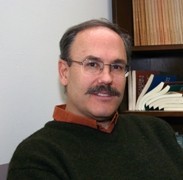 |
| Professor Chris Phillips |
Professor Phillips is a Lincoln scholar and a specialist in the history of the Civil War and Reconstruction. More specifically, Phillips' research focuses on the American South, with particular interest in the Border States, the slave states that did not secede during the American Civil War. His book “The Rivers Ran Backward: The Civil War on the Middle Border and the Making of American Regionalism” is scheduled to appear in 2015.
UC History
Professor Ethan Katz was recently quoted in an article on the
Jewish and Israeli News website.
"Holocaust Seen as ‘camouflage for Hate’ at Kristallnacht’s 75th anniversary" , written by Alina Dain Sharon, addresses the issues of remembrance of the Kristallnacht, while also arguing "remembrance of the atrocity does not address the problem of modern anti-Semitism, which is often masked as anti-Zionism."
 |
| World Jewish Congress President Ronald S. Lauder addresses the Conference of European Rabbis commemoration of the 75th Anniversary of Kristallnacht in Berlin on Nov. 10. |
During Kristallnacht, the “Night of Broken Glass,” from Nov. 9-10, 1938, Nazi officials and German civilians killed more than 1,000 Jews and vandalized more than 7,000 businesses, a turning point in the Nazi era that foreshadowed the Holocaust atrocities to come. Dr. Katz provides important historical context for the article and the 75th anniversary of Kristallnacht in general. Katz says “before Kristallnacht many Jews had retained the hope that the anti-Semitism of the period would pass.” Adding to his historical comments of the event, Dr. Katz also connects it to modern issues, saying “attempts to decontextualize the Holocaust and turn it into a basis for political comparisons and attacks have become rampant—in American politics, in certain contexts in Europe, and in debates around the Israeli-Arab conflict. Without extreme care and precision, such references generally distort more than they reveal.”
Professor Katz is a historian of modern Europe and the Mediterranean, with specialties in the history of modern France and its empire and modern Jewish history. He is currently completing a book on the history of Jewish-Muslim relations in France since World War I.
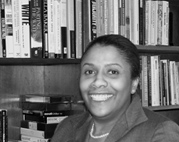 |
| Professor Nikki Taylor |
A quick heads-up to let you know of some of our historians in the news these days!
African-American history expert, Professor Nikki Taylor, recently appeared in a new television documentary hosted by Henry Louis Gates, Jr., The African Americans: Many Rivers to Cross, which debuted on PBS in October. In The Age of Slavery, episode 2 of the documentary, Prof. Taylor is featured in a riveting segment focused on the compelling and tragic story of Margaret Garner, a runaway slave who, after her capture, murdered her own daughter rather than allow her to be forced back into a life of slavery. For more on the documentary, see the web site, which allows you to view a number of the episodes (including episode 2 – look to about minute 45 for the segment featuring Prof. Taylor). On the site, you’ll also discover a trove of fascinating details on the African-American experience in our country. http://www.pbs.org/wnet/african-americans-many-rivers-to-cross/


